Hyderabad’s open-plot market has quietly outperformed the apartment segment. In Q2 2025, while flat sales in outer suburbs dipped by over 25% year-on-year, residential plot demand rose 9% quarter-on-quarter — a counter-cyclical shift that has continued into 2026 (Urbanrise Opulence). Average apartment prices in peripheral zones crossed ₹1.25 crore, nudging first-time buyers and long-term investors toward land for greater flexibility and lower entry costs. But buying a plot carries its own risks: the wrong corridor, a missing document, or an unapproved layout can cost you years and lakhs. This guide walks you through the entire journey — from market dynamics and location selection to legal verification, Dharani portal checks, and post-registration tasks — so you can buy an open plot in Hyderabad with clarity at every step.
TL;DR / Quick Answer
To buy an open plot in Hyderabad, shortlist an HMDA- or DTCP-approved layout along a growth corridor, verify the seller’s title through the Dharani portal and Encumbrance Certificate, confirm the NALA conversion certificate, check for TGRERA registration, and register the Sale Deed with approximately 7% stamp duty. Always consult an independent property lawyer and chartered accountant before committing.
Table of Contents
- Why Buy an Open Plot in Hyderabad: 2026 Market Outlook
- HMDA vs DTCP vs Gram Panchayat vs TS-bPASS: Approval Types Explained
- Best Localities to Buy Open Plots (Price per Sq Yd & Appreciation)
- Legal Documents Checklist (Title Deed, EC, Pattadar Passbook, NALA, RERA)
- Dharani Portal & Online Verification (Step-by-Step)
- The Mortgaged Plot Trap & How to Avoid It
- Stamp Duty, Registration & Tax Compliance (TDS, Capital Gains)
- Booking, Sale Agreement & Sale Deed Registration
- Post-Registration: Mutation, Property Tax & Possession
- Red Flags & Common Scams in Hyderabad Plot Sales
- FAQ: Buying Open Plots in Hyderabad
Why Buy an Open Plot in Hyderabad: 2026 Market Outlook
Hyderabad’s residential land market is one of the most resilient segments in South Indian real estate. While apartment sales in outer suburbs fell more than 25% year-on-year in Q2 2025, open-plot demand surged 9% quarter-on-quarter, driven by buyers who saw residential land as a more flexible and cost-efficient asset class (Urbanrise Opulence). That momentum has carried into 2026, with gated community plots along the Outer Ring Road and the emerging Regional Ring Road drawing the strongest interest. A plot gives you control — your builder, your timeline, your design — and historically, land in approved layouts along growth corridors has appreciated well relative to built-up inventory in the same micro-market.
The critical factor is choosing the right corridor before comparing prices. Not every location delivers equal value, and not every seller presents a clean title. A location-first approach — understanding connectivity, employment catchments, and approval context before committing — is what separates a good purchase from a costly mistake. HousingPandas applies this exact philosophy, helping buyers explore Hyderabad’s West growth corridors at their own pace, with clarity before momentum. The 2026 market rewards buyers who do thorough homework on the corridor, not just the plot.
HMDA vs DTCP vs Gram Panchayat vs TS-bPASS: Approval Types Explained
The approval authority behind a layout determines your legal safety, resale potential, and construction permissions. HMDA (Hyderabad Metropolitan Development Authority) covers the metropolitan periphery and carries the strongest resale perception. DTCP (Directorate of Town and Country Planning) governs layouts outside HMDA limits — still a solid approval if the plan is genuine and current. Gram Panchayat layouts in far-flung villages carry the most risk: many lack proper subdivision approvals and face construction-permission denials. TS-bPASS and the Layout Regularisation Scheme (LRS) allow certain gram panchayat plots to be regularised, but not all qualify and the process is not automatic.
In March 2025, the Telangana Real Estate Regulatory Authority (TGRERA) issued Circular No. 607/2025, mandating that any plotted development above 500 square metres — eight or more plots — must be registered with TGRERA before marketing or sale. This registration forces developers to maintain escrow accounts, submit approved plans, and disclose any litigation. When evaluating a layout, confirming the approval type and cross-checking it against the relevant authority’s official records is where HousingPandas’ careful, due-diligence-first evaluation begins. Always verify independently — a developer’s brochure is not proof of approval.
Best Localities to Buy Open Plots (Price per Sq Yd & Appreciation)
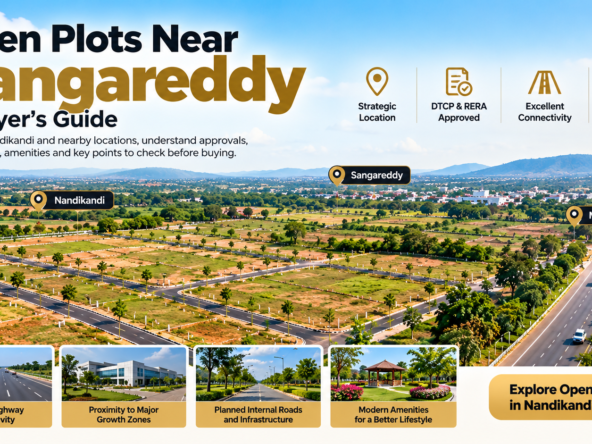
Hyderabad’s open-plot landscape is shaped by infrastructure corridors. The ORR created the first wave of peripheral growth; the Regional Ring Road and expressway projects are creating the second. Along the Srisailam Highway corridor, areas like Adibatla and Raviryal benefit from aerospace and IT SEZ momentum. The Mumbai Highway belt through Sangareddy and Nandikandi draws strength from pharma and industrial employment hubs. The northern zone around Medchal and Shamirpet attracts end-use buyers priced out of the core city. Emerging areas like Shadnagar and Kothur on the Bengaluru Highway serve as longer-horizon plays, with per-square-yard rates varying widely based on proximity to ORR exits and layout approvals.
For buyers focused on West Hyderabad, the Sangareddy–Nandikandi and Nawabpet–Mobility Valley corridors deserve close attention. Both sit along planned or operational expressway alignments and offer gated community options with RERA and DTCP approvals. You can explore open-plot opportunities in Hyderabad’s growth corridors or view Hyderabad plot locations across the West Hyderabad corridor to compare these micro-markets. Location-first thinking means evaluating connectivity and employment catchments before comparing sticker prices — a corridor that looks cheaper today may lack the infrastructure backbone to appreciate meaningfully.
Legal Documents Checklist (Title Deed, EC, Pattadar Passbook, NALA, RERA)
Document verification is the step most buyers rush through — and the one that matters most. At minimum, examine the Title Deed (confirming the seller’s ownership chain for at least 30 years), the Encumbrance Certificate (EC) for the same period to rule out outstanding loans or legal claims, and the Pattadar Passbook if the land was ever classified as agricultural. The NALA (Non-Agricultural Land Allotment) conversion certificate is frequently overlooked: without it, agricultural land cannot legally be used for residential purposes, and the layout’s approval status becomes questionable. For TGRERA-registered projects, verify the registration number on the authority’s website before proceeding.
Many first-time plot buyers are unsure where to begin this process. See how a structured discovery-to-decision journey works — the Evaluate stage is designed to prompt exactly these document questions before any booking decision. Beyond the core documents, ask for the layout’s approved plan from HMDA or DTCP, the building-line setback details, and any active litigation history. Engage an independent property lawyer to verify originals, not photocopies. If the seller hesitates to share documents, treat that hesitation as a red flag. Clean paperwork is the foundation of a clean purchase.
Dharani Portal & Online Verification (Step-by-Step)
Telangana’s Dharani portal (dharani.telangana.gov.in) is the state’s centralised land records system and your first line of defence against ownership fraud. Navigate to “Land Details,” search by survey number, district, and mandal to view the current pattadar (owner), land extent, and recorded mutations. If the seller’s name doesn’t match the pattadar record, pause — either the mutation hasn’t been updated (fixable with proper documentation) or the seller lacks clean title (not fixable). You can also pull the Encumbrance Certificate online through the Registration & Stamps Department’s portal for additional assurance against hidden liens or legal claims.
The portal isn’t flawless: it may not reflect very recent transactions in the pipeline, and rural survey boundaries sometimes mismatch on-ground measurements. Treat it as a strong starting point, not the final authority. For gated community plots, cross-reference the developer’s TGRERA registration against Dharani’s survey boundaries and request the layout’s approved plan. Any discrepancy between portal data and physical documents must be resolved before you pay a booking amount. Use digital verification alongside on-ground checks and professional legal review for the most reliable outcome.
The Mortgaged Plot Trap & How to Avoid It
A scenario that catches buyers off guard: the title deed checks out, the EC is clean, the site visit looks legitimate — but the layout developer has pledged 15% of the plots as mortgage to HMDA or DTCP as a condition of layout approval. This is a standard requirement meant to guarantee infrastructure completion (roads, drainage, electricity). If the developer defaults on those obligations, the mortgaged plots cannot be sold, transferred, or legally registered. Buyers who’ve already paid the full amount discover they’re holding a receipt for land they can’t own until the mortgage is released by the authority.
The fix is straightforward: before booking, ask the developer for a “release letter” from HMDA or DTCP confirming that your specific plot — identified by survey number and plot number — has been released from the mortgage. The letter should be on the authority’s official letterhead. Don’t accept verbal assurances that “all plots are clear” without seeing this document for your exact unit. Established corridors with multiple completed layouts are statistically less likely to carry unresolved infrastructure obligations, which is one more reason a location-first approach pays off. Verify, then commit.
Stamp Duty, Registration & Tax Compliance (TDS, Capital Gains)
In Telangana, stamp duty on a plot sale is typically 5% of the property value, with a 1.5% transfer duty and a 0.5% registration fee, bringing the total to approximately 7%. The stamp duty is calculated on either the agreed sale consideration or the government’s guideline value (circle rate) — whichever is higher. Under-reporting the sale value to reduce stamp duty is illegal and can trigger penalties from the Registration Department. Always confirm current rates with the Sub-Registrar’s Office before your transaction, as rates may be revised.
On the tax side, if the plot value exceeds ₹50 lakh, the buyer must deduct 1% TDS under Section 194-IA of the Income Tax Act and file Form 26QB before registration. The seller is liable for capital gains tax — short-term gains (plot held under 24 months) are taxed at slab rates, while long-term gains (held over 24 months) are taxed at 12.5% with indexation benefits. These are informational guidelines, not professional tax advice — consult a qualified chartered accountant for your specific situation. If you need help getting started on your plot search, WhatsApp HousingPandas to start a guided exploration.
Booking, Sale Agreement & Sale Deed Registration
Once you’ve shortlisted a plot and completed due diligence, the transaction typically unfolds in three stages. First, a booking amount is paid to reserve the plot — ensure you receive a written receipt confirming the exact plot number and the terms under which the booking is refundable. Second, a Sale Agreement is executed on stamp paper, specifying the total consideration, payment schedule, timeline for registration, and penalties for default by either party. This agreement gives you a contractual right to the plot but does not transfer ownership. Third, the Sale Deed is registered at the Sub-Registrar’s Office in the jurisdiction where the plot is located.
At the registration stage, both buyer and seller (or their power-of-attorney holders) must appear in person with original documents, identity proofs, passport-size photographs, and the stamp duty payment receipt. Two witnesses are required. Understanding the booking-to-registration pathway helps you move from evaluation to a confident, well-documented transaction. A practical tip: never pay the full consideration before registration. Hold back a reasonable portion until the Sale Deed is executed and the mutation process has been initiated in your name.
Post-Registration: Mutation, Property Tax & Possession
Registration isn’t the finish line. After the Sale Deed is executed, you need to apply for mutation — updating the Pattadar Passbook in your name — on the Dharani portal. This requires uploading the registered Sale Deed, identity proof, and the seller’s details. Until mutation is complete, government records still show the previous owner, which can create issues for property tax assessment, building-permission applications, and future resale. Follow up proactively with the tehsildar’s office, as processing delays are common in practice.
Once mutation clears, register for property tax with the local municipal body or gram panchayat. In approved HMDA and DTCP layouts, property tax is assessed based on the plot’s location, size, and guideline value. Take physical possession by verifying boundary stones or fencing, and confirm whether the layout’s common areas — roads, parks, drainage networks — have been handed over by the developer to the local authority. If you’ve purchased through a guided process, the post-purchase phase matters as much as the search phase: stay engaged until every record reflects your ownership correctly.
Red Flags & Common Scams in Hyderabad Plot Sales
Fraud in Hyderabad’s plot market follows predictable patterns. “Farm plot” schemes sell agricultural land in unauthorised layouts at suspiciously low prices, promising future regularisation that never comes. In February 2025, HYDRAA Commissioner A.V. Ranganath publicly warned citizens against such purchases, citing the Telangana Municipal Act 2019 and confirming that the Stamps & Registration Department has been instructed to refuse registration of non-compliant farm plots (The Siasat Daily). Since GO No. 131 (August 2020), no construction permissions have been granted in these layouts, and illegal structures face demolition.
Other warning signs include developers who refuse to show original documents, layouts marketed without TGRERA registration (mandatory for projects above 500 sq. metres), pricing dramatically below surrounding rates without a credible explanation, and “last plot” urgency tactics designed to rush your decision. In one documented enforcement action, TGRERA fined an infrastructure firm ₹4.5 lakh for fraud in a plotted project (Times of India). Starting with location evaluation — not price — is your strongest defence. Be patient, verify everything, and walk away from deals that don’t add up.
Conclusion
Buying an open plot in Hyderabad is a meaningful decision, and the 2026 market offers real opportunities for buyers who approach it methodically. Start with the corridor: understand connectivity, employment drivers, and infrastructure plans before comparing prices. Verify approvals (HMDA, DTCP, TGRERA), confirm the title through the Dharani portal, check the NALA conversion, and inspect the release letter if the layout carries any mortgage. Register the Sale Deed correctly, complete the mutation, and take documented possession. Each step matters. If you’d like a guide rather than a sales pitch, talk through your plot search with HousingPandas — clarity at your own pace, with the right questions asked at every stage.
FAQ: Buying Open Plots in Hyderabad
What is the best way to buy an open plot in Hyderabad?
Shortlist HMDA- or DTCP-approved layouts in a growth corridor, verify ownership through the Dharani portal and Encumbrance Certificate, confirm TGRERA registration, and register the Sale Deed with an independent lawyer’s review.
What is the stamp duty for buying a plot in Telangana in 2026?
Stamp duty is approximately 5%, plus 1.5% transfer duty and 0.5% registration fee, totalling about 7%. Confirm current rates with the Sub-Registrar’s Office before your transaction.
How do I verify a plot on the Dharani portal?
Visit dharani.telangana.gov.in, navigate to “Land Details,” and search by survey number, district, and mandal to check the current pattadar (owner), land extent, and recorded mutations.
What is a NALA conversion certificate, and why do I need it?
NALA (Non-Agricultural Land Allotment) is a certificate that converts agricultural land for non-agricultural use. Without it, residential construction on the plot may not be legally permitted.
What is the mortgaged plot trap?
Developers often pledge 15% of plots to HMDA or DTCP as infrastructure security. If the mortgage is never released, those plots cannot be registered. Always request a release letter for your specific plot before booking.
Is it safe to buy gram panchayat plots near Hyderabad?
Gram panchayat layouts carry higher risk due to approval gaps. Some can be regularised under TS-bPASS or LRS, but not all qualify. Verify the approval status independently before purchasing.
How much TDS do I pay on a plot purchase above ₹50 lakh?
The buyer must deduct 1% TDS under Section 194-IA of the Income Tax Act and file Form 26QB before registration. Consult a qualified chartered accountant for compliance specifics.
Where can I find RERA-approved plots in Hyderabad?
TGRERA’s website (rera.telangana.gov.in) lists registered projects. You can also contact HousingPandas for guided assistance in evaluating approved open-plot opportunities in Hyderabad’s growth corridors.