Quick Answer
In most Hyderabad layouts, a corner plot gives you two open sides, easier access and more design freedom, while a middle plot usually costs less for the same size and sits deeper inside the community. Neither is automatically better. The right choice depends on your budget, the layout’s road pattern, how much privacy you want, and what you plan to build. Check the exact plot on the ground, its entry orientation and the official layout plan before you decide, and follow the approvals and documents guidance from the layout’s developer.
What “Corner” and “Middle” Actually Mean in a Layout
Before comparing, it helps to be precise about terms, because sellers use them loosely.
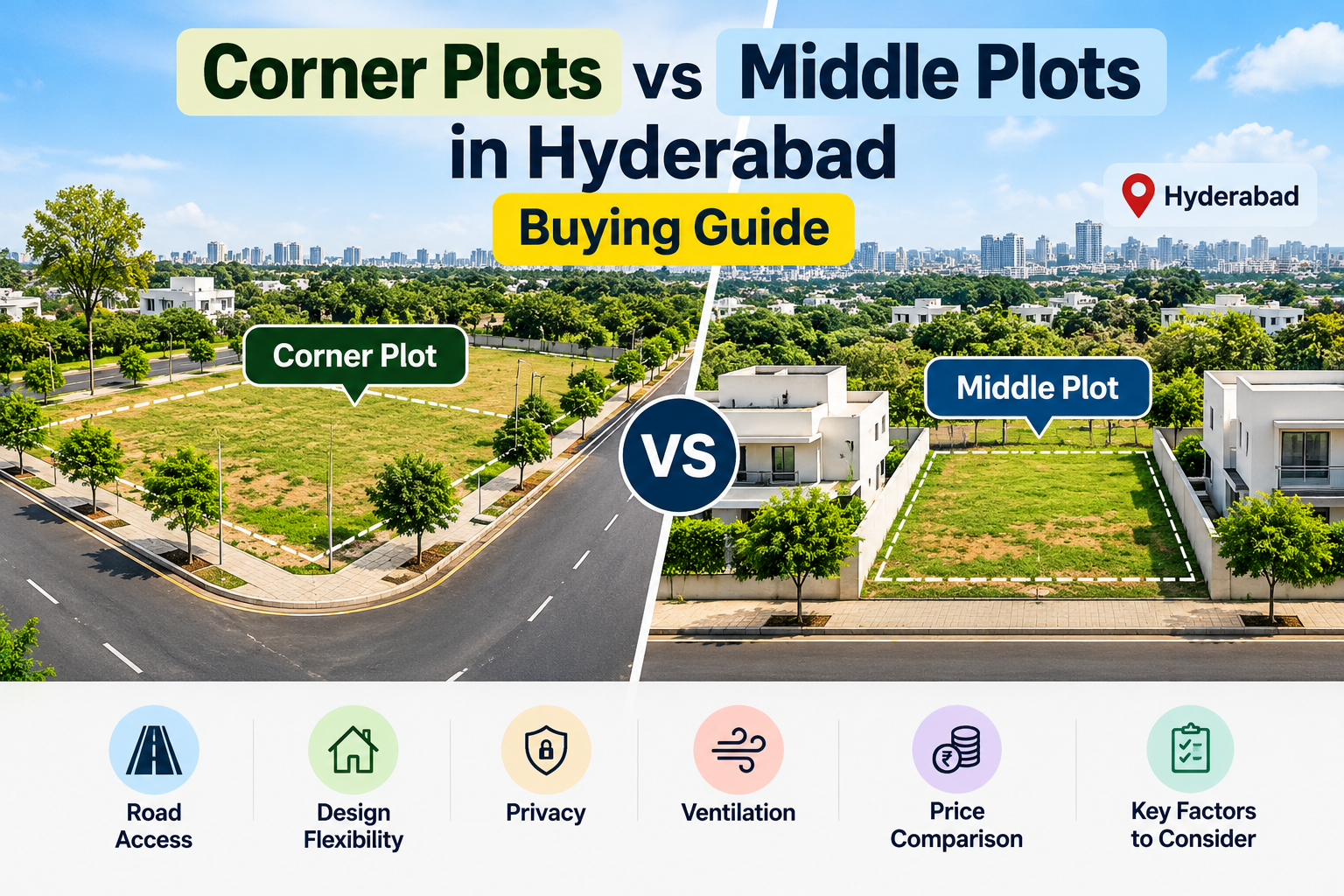
A corner plot sits where two internal roads meet. Two of its sides face a road, and two sides touch neighbouring plots. In some layouts you will also hear “two-side open” or “road on two sides”, which means the same thing.
A middle plot (sometimes called an interior plot) has one side facing a road and the other three sides touching neighbouring plots. Most plots in any grid layout are middle plots, which is simply a matter of geometry: a grid has far more interior positions than corners.
There is also an in-between case buyers often miss: a plot that is not on a corner but has a road on two sides because it faces a T-junction or sits across from a park or open space. Treat these as their own category and evaluate them on their specific merits rather than assuming they behave like corner plots.
Why Corner Plots Attract Attention
Corner plots tend to get noticed first when buyers walk a layout, and there are practical reasons behind that.
Light and ventilation on two sides. With two road-facing sides, a future home can take windows and openings from two directions. In Hyderabad’s climate, where cross-ventilation makes a real difference through the long warm months, that extra exposure is useful. A middle plot home can still be well ventilated, but the design has to work harder for it, usually with setbacks, courtyards or skylights.
Design flexibility. Two road-facing sides give an architect more options for placing the entrance, parking and garden. If the layout’s rules allow it, you may be able to orient the main door toward one road and the car entry toward the other. On a middle plot, everything enters from the same side, so driveway, entrance and utility access share one frontage.
Easier access during construction. Material deliveries and machinery can approach from two sides, which sometimes makes the construction phase logistically simpler. This is a small point, but anyone who has watched a cement lorry squeeze into a narrow single-access lane will appreciate it.
Visibility. Some buyers simply like that a corner home is more visible and easier for guests and deliveries to find. If you ever plan a small clinic, office or shop-like use on the ground floor where rules permit, visibility matters more, though you must confirm what the layout and zoning actually allow before planning any non-residential use.
The Real Trade-Offs of Corner Plots
Corner plots also carry disadvantages that brochures rarely mention.
Higher cost for the same area. Corner plots are usually priced at a premium over middle plots in the same layout. The premium varies by project and market conditions, so ask for the current per-square-yard rate for both plot types in the specific layout you are considering rather than relying on general rules of thumb.
Traffic on two sides. Two roads mean two sides of vehicle movement, headlight glare and honking. If one of those roads is the layout’s main internal road, the traffic is not trivial. Visit the plot at busy hours, typically morning and evening, and stand there for a few minutes. What feels charmingly open at noon can feel exposed at 6 pm.
Privacy and boundary walls. Two open sides usually mean longer boundary walls and more of your home visible from outside. Taller walls solve some of this but add cost, and many gated layouts regulate wall height and design.
Corner setbacks and visibility rules. Many approved layouts require larger setbacks or sight-line clearances at corners so drivers can see around the bend. That can reduce your usable built-up area compared with what the plot dimensions suggest on paper. The layout’s approval conditions and the local body’s building rules decide this, so verify on the official layout plan and with the approving authority’s norms rather than assuming the full plot is buildable.
Turning radius and compound corners. In practice, some corner plots lose a small triangle or curve at the corner itself to road widening or turning radius requirements shown on the approved plan. Measure what is actually usable.
Why Middle Plots Deserve a Fair Look
Middle plots are less glamorous in conversation but often the sensible buy.
Better value per square yard. For the same budget, you frequently get a larger middle plot than a smaller corner plot. If your priority is built-up space for a growing family rather than frontage, the middle plot quietly wins.
Calmer living. One road-facing side means less passing traffic, less noise and fewer headlights sweeping your windows at night. Buyers with young children or elderly parents often end up preferring this once they experience both options on the ground.
Neighbours on three sides. This cuts both ways, but in established layouts it often means a more settled, enclosed feel and clearer expectations about what will be built around you.
Simple drainage and grading. With one road level to match, getting the plot’s plinth height and driveway slope right is usually more straightforward than reconciling two different road levels on a corner.
The Trade-Offs of Middle Plots
Single frontage. All access, parking and services come from one side. If that road is narrow, a wide car and a compound gate need careful planning.
Light depends on orientation. With only one open side, the plot’s facing direction matters more. A middle plot facing a favourable direction can be brighter than a poorly oriented corner plot, which is why facing deserves its own evaluation rather than being folded into the corner-versus-middle question.
Future blockage risk. Your light and air come from the road side and whatever neighbours build on the other three sides. Look at the surrounding plots: if the ones beside and behind are sold and likely to be built soon, picture the layout after those houses go up.
Checks That Matter More Than Corner or Middle
Experienced buyers treat the corner-versus-middle debate as secondary to a handful of checks that decide whether a plot is good at all.
1. Approvals and title first. Confirm the layout’s approval status, the plot’s title chain and the encumbrance position before comparing micro-locations. A corner plot in a problematic layout is worse than a middle plot in a clean one. Walk through the documents with the checklist approach: approvals, link documents, encumbrance certificate and the seller’s identity, and have an independent lawyer verify rather than relying on the seller’s copies alone. Our open plot documents checklist for Hyderabad buyers lists what to collect.
2. The approved layout plan. Ask for the official approved plan, not just the marketing layout. It shows road widths, open spaces, setbacks and any reservations that affect both corner and middle plots. Our guide on reading an open plot layout plan in Hyderabad covers how to check what is shown against what exists on the ground.
3. Road width and pattern. A corner of two narrow lanes is very different from a corner where a wide main road meets a smaller one. Wider internal roads generally mean easier access and better future resale visibility, but also more traffic. Match the road pattern to how you actually live.
4. Entry orientation. Check which side the practical entrance falls on and whether that suits your plans. Many buyers have preferences about the direction the main door faces; confirm the plot can accommodate yours within the layout’s rules.
5. Levels and drainage. Stand on the plot after rain if you can. Low spots, water flowing toward the plot from the road, or a plot sitting below road level all cost money to fix later, whether the plot is corner or middle.
6. Utilities on the ground. Confirm where the water line, power feed and drainage actually run relative to the plot. On corner plots, utility corridors sometimes run along one road edge, which can affect compound wall and gate placement.
Corner Plots in Gated Communities vs Open Layouts
The corner-versus-middle calculation changes with the type of layout. In a gated community with internal speed limits, controlled entry and mostly resident traffic, the traffic disadvantage of a corner plot shrinks considerably. The two open sides then give you light and design freedom with little of the noise penalty, which is part of why corner plots in good gated communities get picked early.
In an open layout that connects to public roads, a corner plot can face genuinely busy through-traffic, and in some cases a road that gets widened later. Check whether either adjoining road is marked for widening on the approved plan or the local master plan, and treat a corner facing a future main road very differently from a corner inside a quiet grid.
T-Junction and Dead-End Plots
Two related positions deserve a mention. A plot facing a T-junction, where a road points straight at it, gets the same openness as a corner without technically being one. Some buyers like the visibility; others dislike headlights aimed at the house every night and prefer to avoid it. A plot at a dead end or cul-de-sac offers the opposite: almost no passing traffic, high privacy, and a settled feel, at the cost of slightly longer drives in and out. Both are worth considering deliberately rather than accepting or rejecting by default.
Common Mistakes Buyers Make on This Decision
Paying the corner premium without checking setbacks. If corner clearances eat into your planned footprint, you may end up with less usable space than a cheaper middle plot offers. Do the buildable-area arithmetic before paying extra.
Choosing middle for savings, then regretting orientation. A middle plot facing a direction you dislike is a permanent compromise. Check facing before celebrating the savings.
Comparing brochure dimensions instead of measured plots. Visit with a tape or a measuring wheel, or ask for a survey. Corners sometimes lose area to road rounding that the brochure does not show.
Ignoring what will surround the plot. Look at the layout plan for what is planned on adjoining plots and across the road, including any amenities, transformers or commercial reservations. A peaceful middle plot opposite a future community hall will not stay peaceful.
A Simple Way to Decide
If you are stuck between a specific corner plot and a specific middle plot in the same layout, score them on the things you cannot change later:
Budget fit. Does the corner premium crowd out money you need for construction? A house half-built on a premium plot is a worse outcome than a finished home on a middle plot.
Noise and privacy tolerance. Visit both plots at morning and evening peak. Your own comfort in those ten minutes tells you more than any comparison table.
Buildability. After setbacks and corner clearances, how much usable area does each plot really give you for the home you plan? Get this from the approved plan and applicable building rules, not from the brochure dimensions.
Access. Which plot makes daily life easier: gate placement, guest parking, delivery access?
Resale audience. Both types sell. Corner plots draw attention; middle plots draw budget-conscious family buyers. Either is liquid in a genuinely good layout, and the layout’s quality matters more than the plot’s position in it.
Frequently Asked Questions
Is a corner plot always more expensive? Usually there is a premium in the same layout, but the amount varies by project and over time. Ask the developer for current rates for both plot types in writing and compare like for like.
Do corner plots have setback disadvantages? Often they have additional corner clearance or visibility requirements under the layout’s approval conditions and local building rules. Verify on the approved plan and with the approving authority before assuming the full area is buildable.
Is a middle plot bad for ventilation? Not automatically. Orientation, road width and neighbouring construction matter as much as position. A well-oriented middle plot with a wide road in front can outperform a boxed-in corner plot.
Should I pay a premium just because everyone prefers corners? Pay for the advantages you will actually use. If two-side light and access matter to your plans, the premium can be worth it. If you will wall off one side and use a single entrance anyway, you are paying for a feature you will not enjoy.
Do corner plots resell faster? They attract attention early because they are fewer and more visible, but actual resale depends on the layout’s overall demand, road quality and how well the plot has been maintained. In a sought-after layout, clean middle plots also move quickly.
Is a corner plot good for a rental or mixed-use plan? Only if the layout’s rules and zoning allow the intended use. Many approved residential layouts restrict commercial activity regardless of plot position, so confirm permitted use in writing before paying a corner premium for a plan that may not be allowed.
What matters more than corner or middle? Clean title and approvals, the approved plan, road width, levels and drainage, and the layout’s overall quality. Position within a good layout is a refinement, not the foundation.
The Bottom Line
Corner plots offer openness, flexibility and visibility at a premium. Middle plots offer value, calm and simplicity. Neither wins in the abstract. Walk both plots at different times of day, verify the approved plan and documents first, count the usable area after setbacks, and then let your budget and how you actually live make the call. A well-chosen middle plot in a strong layout will serve you better than a strained budget on a corner.